project team
midtown renaissance group
mcnellies group
lingo construction
crafton tull
obelisk engineering
lancorp engineering
awards
2017 | AIA Central States Excellence in Architecture Merit
2016 | ULI Impact Award – Best Small-Scale Infill Project
2015 | AIA OK Excellence in Design Commercial Merit
2015 | Precast Concrete Institute: Best Mixed Use Building
press
2017 | midcoast design record AIA Central States Awards
2016 | newsok.com ULI OK Honors Urban Projects
2015 | precast concrete institute “2015 Design Awards”
2015 | journal record MT Man: Fitzsimmons Leaves Mark
2015 | oklahoma gazette “Arch Week Celebrates Talent”
2015 | oklahoma gazette Cover Story: Dust Bowl, Fassler Hall
2014 | oklahoman.com Dust Bowl Lanes and Fassler Hall
2014 | koco “Midtown in Middle of a Renaissance”
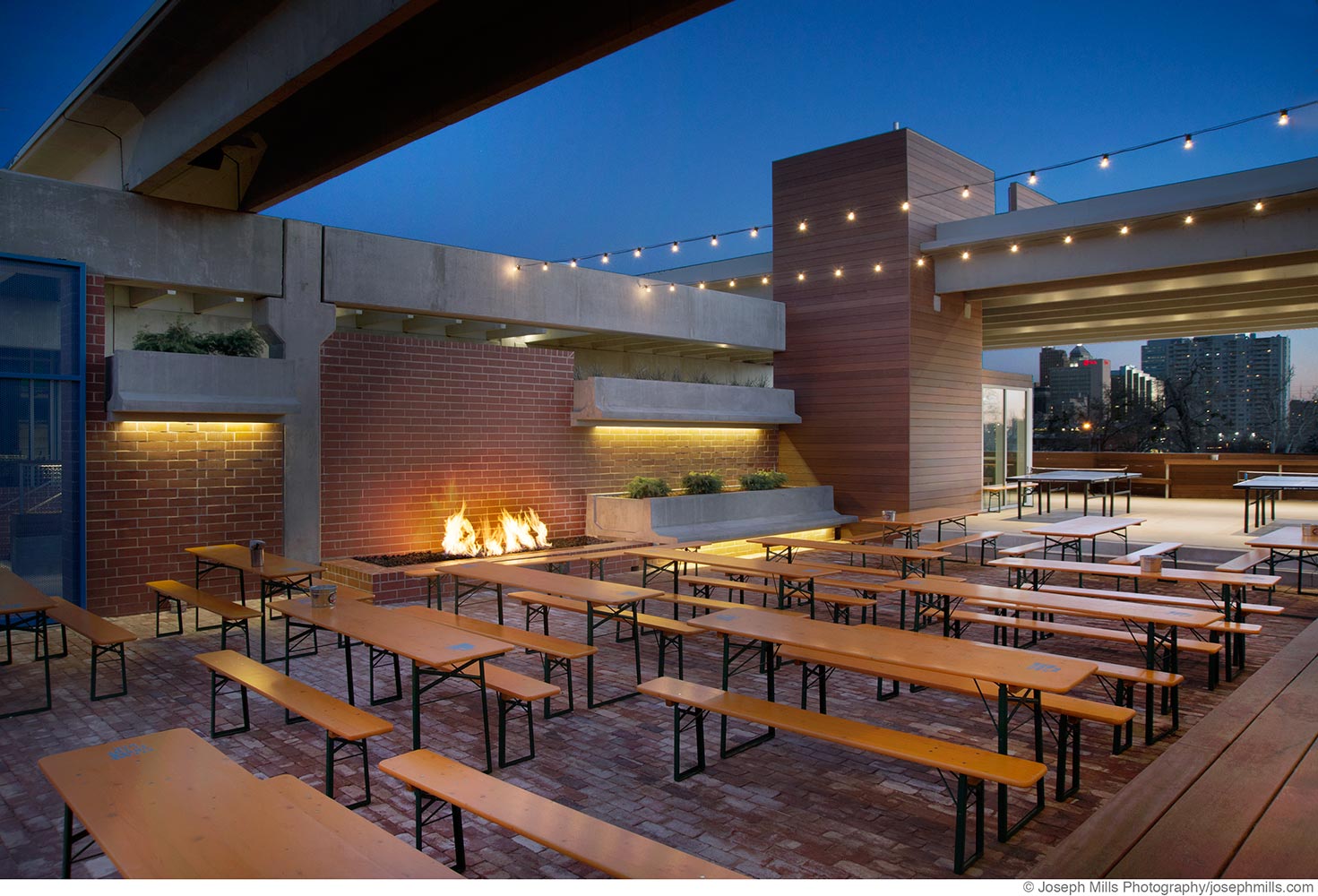
Inspiration for Fassler Hall/Dust Bowl Lounge and Lanes came from existing building types common to the area. Simple materials such as concrete frame with masonry infill make up the bulk of the surrounding early 20th-century buildings. An economical version using precast concrete columns, beam, and tees was used. Integrating two unique entertainment concepts into one building was challenging. This was resolved by creating separate entrances with unique identities for each – the lower level is devoted to the Dust Bowl, while the upper level is devoted to Fassler Hall.
The front facades of the old concrete frame/masonry infill buildings were typically dressed up, so the Dust Bowl tenant’s mid-century theme was allowed to be reflected there. The sides and backs of these buildings are left utilitarian, so for Fassler Hall, the bones were left exposed – fitting for a beer garden. Many of these buildings have had updates over the years with a quilt-work pattern of different colors and finish variations visible in the brickwork. A subtle nod was made to this by using areas of smooth and wire-cut brick in patterns only visible in correct sunlight.
Also of paramount importance was the desire to contribute to a walkable and inviting streetscape. The goal of the facade is to engage the pedestrian. That was accomplished by providing large expanses of storefront to allow views of the activity inside as one walks by. The other was by splitting the building in half and providing access to a plaza off the street that invites the pedestrian to take a detour and explore what lies beyond.
photo
© joseph mills